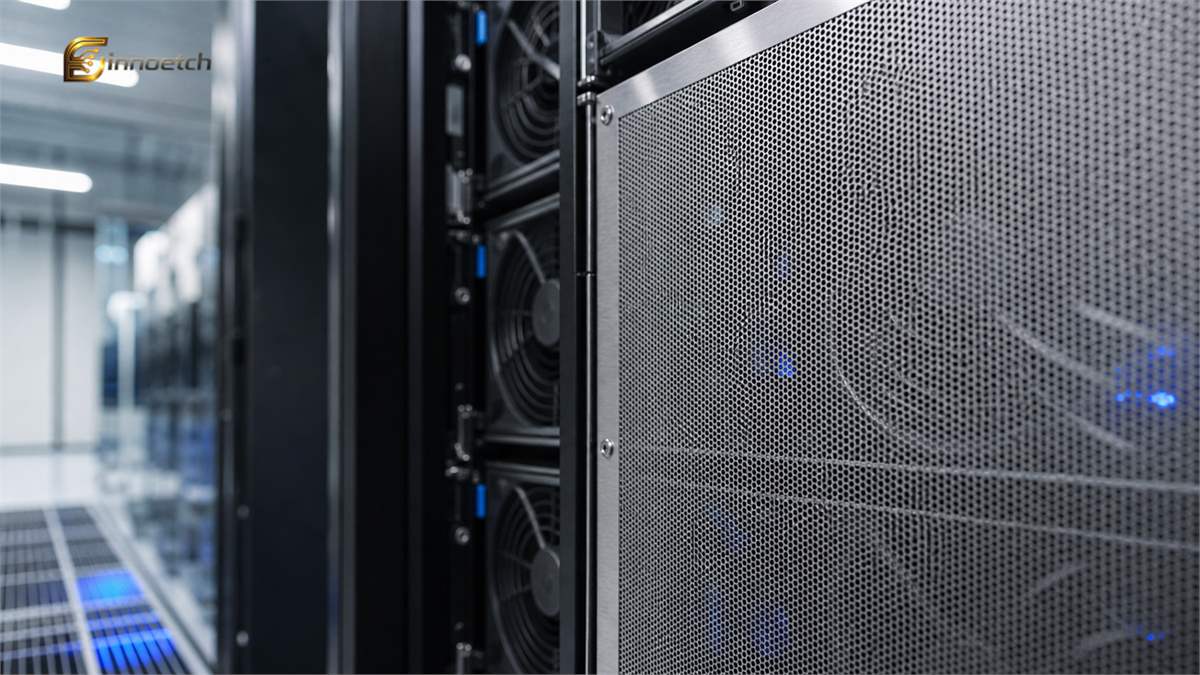
Case study on etched stainless steel dust filter mesh for server cooling, balancing airflow, particle control, and dimensional accuracy.
Why Server Cooling Needs Precision Dust Filter Mesh
Modern servers operate in high-density computing environments where processors, memory modules, storage devices, power supplies, and network components generate continuous heat. Cooling fans must move large volumes of air through compact internal structures, but the same airflow can also bring dust, fibers, and fine particles into the chassis.
Over time, accumulated dust can reduce heat sink efficiency, affect fan balance, increase noise, contaminate electronic assemblies, and raise maintenance costs. For data centers, telecom cabinets, edge computing devices, industrial servers, and AI computing equipment, a reliable dust filter mesh is more than a simple protective cover. It is part of the thermal management system.
INNOETCH provides custom precision etched stainless steel dust filter mesh designed for server intake areas, fan guards, ventilation panels, removable filter frames, and compact cooling modules. Through photochemical etching, the mesh opening pattern, hole size, open area, thickness, and outer profile can be customized according to the airflow, dust protection, and assembly requirements of the cooling system.
Customer Challenge
A server cooling module manufacturer needed a thin stainless steel dust filter mesh for a high-airflow intake structure. The component had to protect internal fans and electronic parts from airborne particles while maintaining stable airflow across the cooling path.
The customer faced several engineering requirements:
High open area to reduce airflow resistance
Uniform micro openings for consistent filtration performance
Burr-free edges to prevent particle shedding and assembly scratches
Thin stainless steel material for compact server structures
Accurate outer dimensions for automated assembly
Good flatness for installation into a filter frame
Long-term corrosion resistance in controlled equipment environments
Traditional punching and mechanical perforation were not ideal for this design because small hole patterns can cause burrs, deformation, tooling limitations, and inconsistent edge quality. Laser cutting was also less efficient for dense micro-hole arrays and could leave heat-affected edges. The customer required a process that could produce fine, repeatable openings without mechanical stress.
INNOETCH Solution: Photochemical Etching for Stainless Steel Filter Mesh
INNOETCH recommended precision photochemical etching as the manufacturing process for the stainless steel dust filter mesh. Chemical etching removes metal through a controlled photoresist and etching process, allowing complex micro-perforated patterns to be produced without stamping pressure, tool wear, or cutting stress.
For this server cooling application, INNOETCH engineers reviewed the customer's airflow target, dust protection needs, installation frame, material thickness, and dimensional requirements. The mesh design was optimized to balance particle blocking performance with ventilation efficiency.
Key design considerations included:
Hole diameter and pitch to control filtration and air permeability
Open area ratio to reduce pressure drop across the fan intake
Mesh thickness to maintain rigidity while fitting compact assemblies
Edge allowance for reliable bonding, clamping, or frame installation
Surface quality to reduce burrs, loose particles, and contamination risk
Stainless steel grade selection based on strength, corrosion resistance, and cost
Because photochemical etching does not rely on hard tooling for every hole shape, the customer could test different mesh patterns during the prototype stage. Round holes, square holes, hexagonal openings, slotted patterns, and custom ventilation layouts can be evaluated before moving into batch production.
Manufacturing Advantages
Precision etched stainless steel mesh offers several advantages for server cooling systems.
First, the process supports dense micro-hole patterns with stable repeatability. This helps maintain consistent airflow distribution across the server intake surface and reduces local hot spots caused by uneven ventilation.
Second, etched openings have smooth, burr-free edges. For electronic equipment, burr control is critical because loose metal particles, sharp edges, and scratches can create reliability risks during assembly and operation.
Third, chemical etching minimizes mechanical deformation. Thin stainless steel sheets can be processed without punching force, which helps preserve flatness and dimensional stability for filter frames and fan modules.
Fourth, the design can be customized quickly. Engineers can adjust hole size, pitch, open area, outer contour, mounting tabs, alignment holes, and identification features according to each server platform.
Finally, stainless steel provides strong durability, corrosion resistance, and cleanability. Compared with some polymer filter materials, stainless steel mesh can offer better structural stability, higher temperature resistance, and longer service life in demanding equipment environments.
Application Results
After prototype validation, the precision etched stainless steel dust filter mesh met the customer's requirements for airflow, filtration consistency, and assembly reliability. The mesh maintained a thin profile while providing a stable protective barrier in front of the server cooling fans.
The customer benefited from:
Improved dust protection for internal cooling fans and electronic components
More uniform airflow through the server intake area
Reduced risk of burrs, scratches, and loose particles during assembly
Accurate dimensions for repeatable installation into the filter frame
Flexible design adjustment during prototype development
Scalable production for custom server cooling components
This application demonstrates how precision metal etching can support thermal management, equipment reliability, and compact mechanical design in modern server systems.
Why Choose INNOETCH
INNOETCH Technology (Dongguan) Co., Ltd. specializes in custom precision metal etching solutions for stainless steel, copper, nickel, aluminum, molybdenum, and other metal materials. For dust filter mesh and cooling-related components, INNOETCH can support design optimization, prototype sampling, process development, and stable batch production.
Our etched metal mesh can be used in server cooling systems, data center equipment, telecom devices, industrial electronics, power modules, acoustic vents, protective covers, and other airflow management applications.
If you need a custom precision etched stainless steel dust filter mesh for server cooling, INNOETCH can manufacture parts according to your drawings, material specifications, thickness, hole pattern, open area, and assembly requirements.
FAQ
Can stainless steel etched mesh be customized for different server airflow requirements?
Yes. Hole size, pitch, opening shape, open area ratio, thickness, outer profile, and mounting features can be customized based on airflow, pressure drop, dust protection, and installation needs.
Is chemical etching suitable for fine dust filter mesh?
Yes. Photochemical etching is suitable for fine and dense micro-opening patterns because it produces precise holes without mechanical punching stress or tool wear.
What materials can be used for server dust filter mesh?
Stainless steel is commonly used because it offers strength, corrosion resistance, cleanability, and dimensional stability. Material selection can be adjusted according to the application environment and cost target.
Precision Etched Stainless Steel Dust Filter Mesh for Server Cooling Systems is widely used in precision metal etching applications where clean edges, tight tolerances, complex patterns and stable performance are required. Typical industries include electronics, semiconductors, sensors, fuel cells, acoustic components, EMI shielding, thermal management and precision mechanical parts.
Precision Etched Stainless Steel Dust Filter Mesh for Server Cooling Systems is a precision metal component manufactured by photochemical etching for applications requiring accurate dimensions, smooth edges and reliable performance.
Common materials include stainless steel, copper, brass, nickel silver, titanium, aluminum and other thin metal sheets depending on the application requirements.
INNOETCH can process thin metal materials from approximately 0.02 mm to 1.5 mm, depending on material type, part structure and tolerance requirements.
For many precision etched parts, tolerances can reach ±0.01 mm to ±0.05 mm, depending on material thickness, design complexity and production volume.
Chemical etching does not require expensive hard tooling and can produce fine patterns, complex shapes and burr-free edges without mechanical deformation.
Yes. INNOETCH supports custom drawings, materials, thicknesses, hole patterns, surface finishes, dimensions and prototype-to-mass-production requirements.
2D drawings, DXF files, DWG files, STEP files, material requirements, thickness, tolerance, quantity and application details are recommended for accurate quotation.
You can send your drawings and technical requirements to INNOETCH. Our engineering team will review the design and provide a quotation.