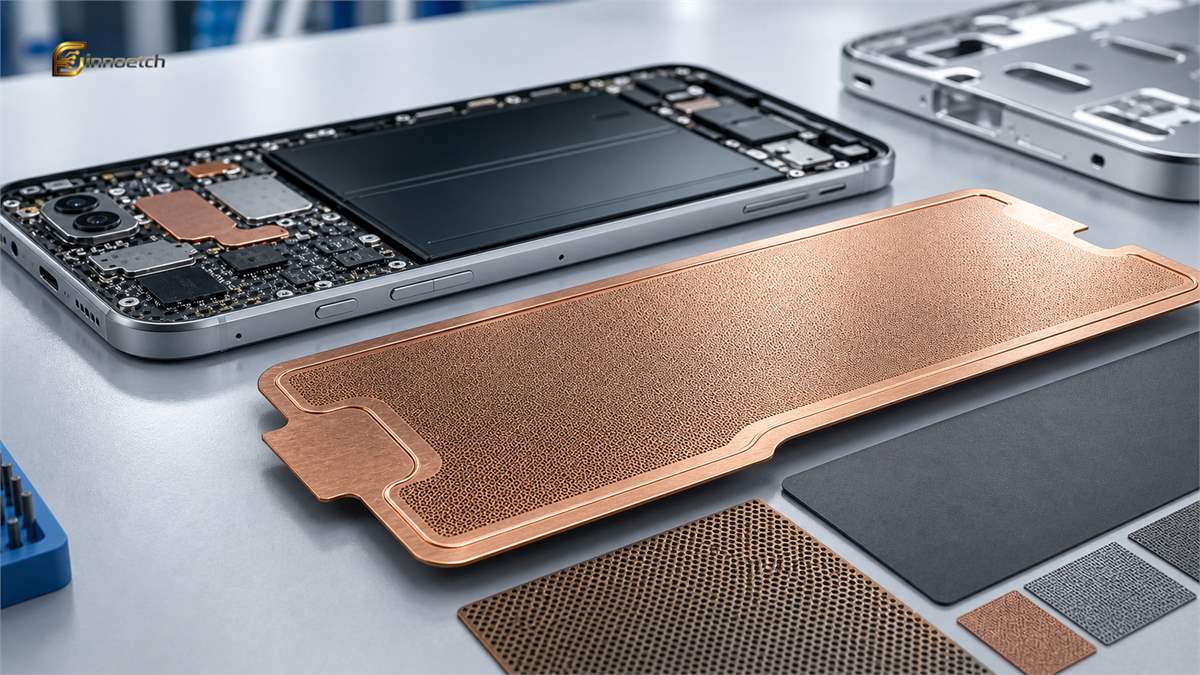
R&D case exploring etched vapor chamber structures for smartphone thermal management, compact layouts, and high-performance cooling.
The Huawei Mate80 series represents the type of flagship smartphone platform where performance density, camera integration, battery capacity, and thin mechanical design must be balanced within a very limited internal space. Although public specifications do not disclose the detailed internal vapor chamber structure, Mate80-level devices create clear engineering demands for advanced heat spreading.
A VC vapor chamber is one of the most effective thermal solutions for high-performance smartphones. Compared with conventional graphite sheets or simple copper plates, a vapor chamber can transfer heat more evenly across a larger area through phase-change heat transport. For flagship phones, this helps reduce localized hot spots around the processor, power management ICs, charging area, and display-side thermal zones.
This application case presents a design-oriented R&D proposal for an ultra-thin smartphone VC vapor chamber, using precision chemical etching to form copper wick structures and micro-channel features.
Modern flagship smartphones face several thermal challenges:
For a Mate80-level device, the VC vapor chamber must be thin, lightweight, uniform, and compatible with complex internal component layouts. It also needs to support reliable sealing, stable capillary performance, and repeatable production quality.
The proposed design uses an ultra-thin copper vapor chamber consisting of an upper cover plate, lower cover plate, etched wick structure, vapor flow area, working fluid cavity, and sealed perimeter. The key engineering focus is the capillary wick, which supports liquid return inside the chamber.
Chemical etching can create fine copper textures, micro-grooves, and controlled channel patterns on thin copper sheets. These features help improve capillary action and heat distribution while keeping the structure thin enough for smartphone integration.
Recommended design points include:
Precision chemical etching is highly suitable for smartphone vapor chamber R&D because it can form detailed patterns without mechanical stress. Unlike stamping or CNC machining, etching does not create burrs, tool marks, or deformation on ultra-thin copper sheets.
For VC vapor chamber development, chemical etching provides several advantages:
Fine wick pattern control
Micro-grooves, porous textures, and channel patterns can be customized according to the heat source layout.
Better design flexibility
Engineers can quickly adjust wick density, channel width, and outline geometry during prototype development.
Thin material compatibility
Etching is suitable for delicate copper foils and thin copper plates used in mobile thermal modules.
Burr-free surface quality
Clean etched features help improve sealing, bonding, and internal fluid movement.
Scalable prototyping
CAD-based tooling supports rapid sample iterations before moving toward pilot production.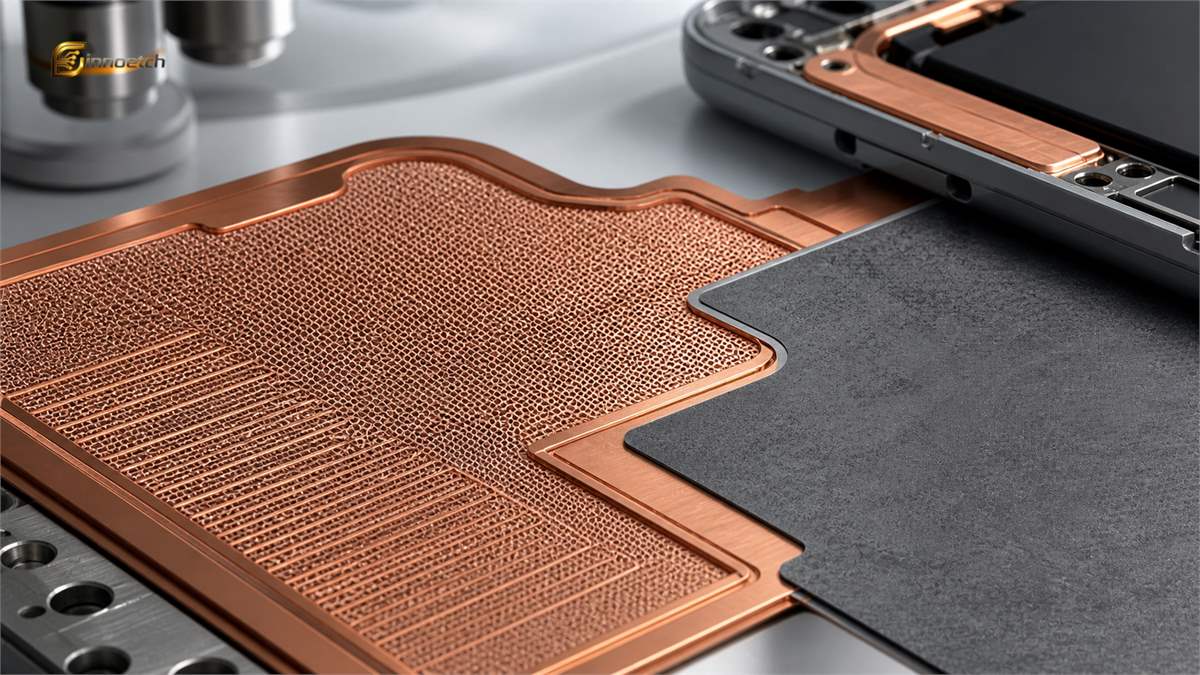
In a Mate80-level flagship smartphone, the main heat source area is typically near the processor and high-performance PCB zone. The VC vapor chamber can be designed to spread heat from this concentrated area toward a wider region under the mid-frame, graphite layer, and display-side structure.
The proposed VC layout may include a denser etched wick pattern near the processor region and a broader vapor flow zone across the main chamber. Peripheral cutouts can be added to match the phone’s internal camera module, battery edge, screw positions, and antenna clearance areas.
This design direction helps achieve:
Innoetch can support copper vapor chamber R&D with precision chemical etching for wick structures, micro-channel patterns, custom outlines, and prototype validation. Customers can provide CAD drawings, copper thickness requirements, target pattern dimensions, and assembly constraints. Our engineering team can review etching feasibility and optimize the design for manufacturability.
For smartphone VC vapor chambers, Innoetch’s process can support:
A VC vapor chamber is a key thermal management component for flagship smartphones such as Mate80-level devices. By using chemical etching to create precise copper wick structures and micro-channel designs, engineers can improve heat spreading performance while maintaining a thin and compact structure.
This R&D design proposal shows how Innoetch’s precision metal etching capabilities can support advanced smartphone thermal management, from early prototype design to manufacturable VC vapor chamber components.
R&D Design Proposal for the VC Vapor Chamber in Huawei Mate80 Smartphones is widely used in precision metal etching applications where clean edges, tight tolerances, complex patterns and stable performance are required. Typical industries include electronics, semiconductors, sensors, fuel cells, acoustic components, EMI shielding, thermal management and precision mechanical parts.
R&D Design Proposal for the VC Vapor Chamber in Huawei Mate80 Smartphones is a precision metal component manufactured by photochemical etching for applications requiring accurate dimensions, smooth edges and reliable performance.
Common materials include stainless steel, copper, brass, nickel silver, titanium, aluminum and other thin metal sheets depending on the application requirements.
INNOETCH can process thin metal materials from approximately 0.02 mm to 1.5 mm, depending on material type, part structure and tolerance requirements.
For many precision etched parts, tolerances can reach ±0.01 mm to ±0.05 mm, depending on material thickness, design complexity and production volume.
Chemical etching does not require expensive hard tooling and can produce fine patterns, complex shapes and burr-free edges without mechanical deformation.
Yes. INNOETCH supports custom drawings, materials, thicknesses, hole patterns, surface finishes, dimensions and prototype-to-mass-production requirements.
2D drawings, DXF files, DWG files, STEP files, material requirements, thickness, tolerance, quantity and application details are recommended for accurate quotation.
You can send your drawings and technical requirements to INNOETCH. Our engineering team will review the design and provide a quotation.