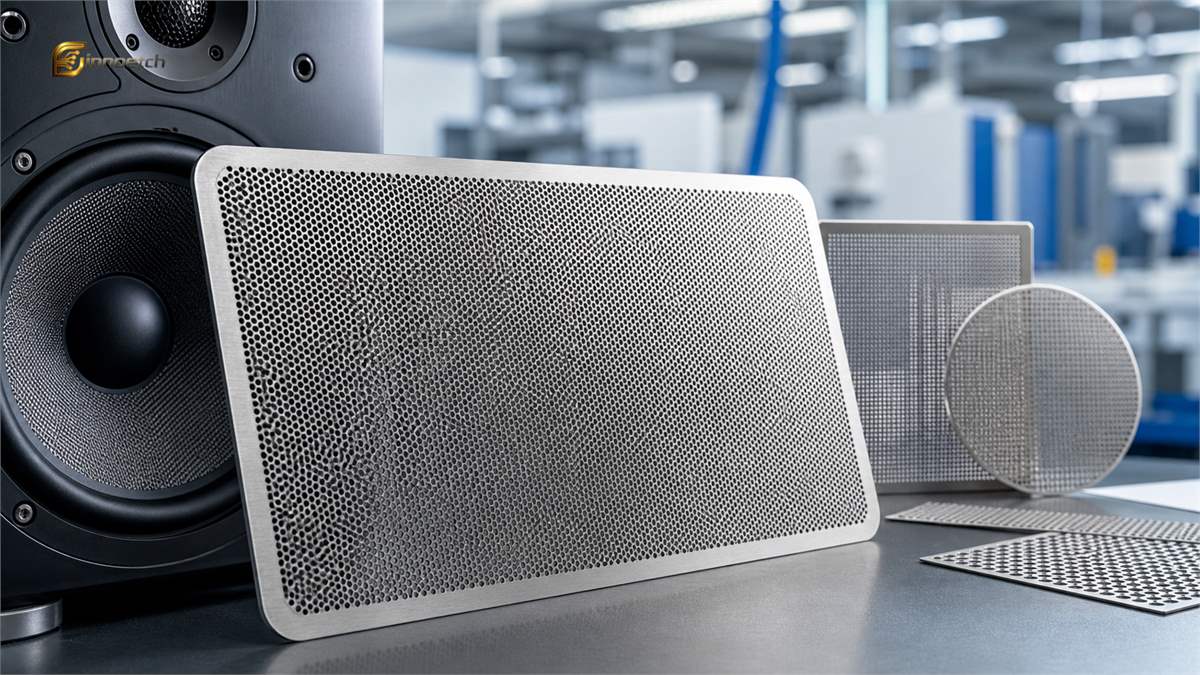
Application case on etched speaker grilles and acoustic mesh, showing how precision openings balance sound, protection, and design.
In premium audio products, the speaker grille is both a protective component and a visible part of the product identity. Whether used in smart speakers, headphones, soundbars, microphones, automotive audio systems, or professional acoustic equipment, the grille must combine mechanical protection with controlled acoustic openness.
Traditional punching or laser cutting can be limited when the design requires ultra-fine holes, dense perforation patterns, thin stainless steel, or smooth decorative surfaces. Chemical metal etching offers a more flexible solution. It removes metal through a controlled photochemical process, allowing complex patterns to be formed without mechanical stress, burrs, or tool wear.
Innoetch manufactures chemically etched speaker grilles and acoustic mesh for applications where precision, appearance, and acoustic performance must work together.
A speaker grille is not just a cover. Its hole size, open area ratio, material thickness, and pattern consistency can influence sound transmission, dust protection, airflow, and product appearance. For compact audio devices, even a small variation in perforation quality may affect assembly fit or visual uniformity.
Metal etching is especially suitable for speaker grille manufacturing because it supports:
For acoustic mesh, the process can create delicate apertures while maintaining material flatness. This helps manufacturers balance sound transparency, protection, and premium industrial design.
Innoetch commonly works with stainless steel, nickel silver, copper alloys, and other thin metal materials depending on the final application. Stainless steel is widely used for speaker grilles because it offers corrosion resistance, strength, and a clean metallic finish.
For portable speakers, headphones, and consumer electronics, etched stainless steel mesh can be produced in thin gauges while maintaining accurate hole geometry. For microphones or acoustic sensors, customized mesh patterns can be designed to support filtration, shielding, and sound transmission requirements.
Surface treatments such as brushing, polishing, blackening, coating, or plating can also be considered after etching to match the product’s final appearance.
For a compact audio device, the customer needed a thin stainless steel grille with a dense hole pattern, clean edges, and a premium visible finish. The grille had to protect the internal speaker while allowing stable acoustic output. Because the design included fine perforations and a custom outer contour, mechanical punching would increase the risk of burrs, distortion, and tooling cost.
Innoetch used photo chemical etching to produce the speaker grille according to the customer’s CAD design. The process enabled consistent aperture size, accurate outer profile, and smooth edge quality across the part. Since no hard die was required, design adjustments could be made quickly during the prototype stage.
The final etched speaker grille provided:
This made the solution suitable for premium audio products where both acoustic function and appearance matter.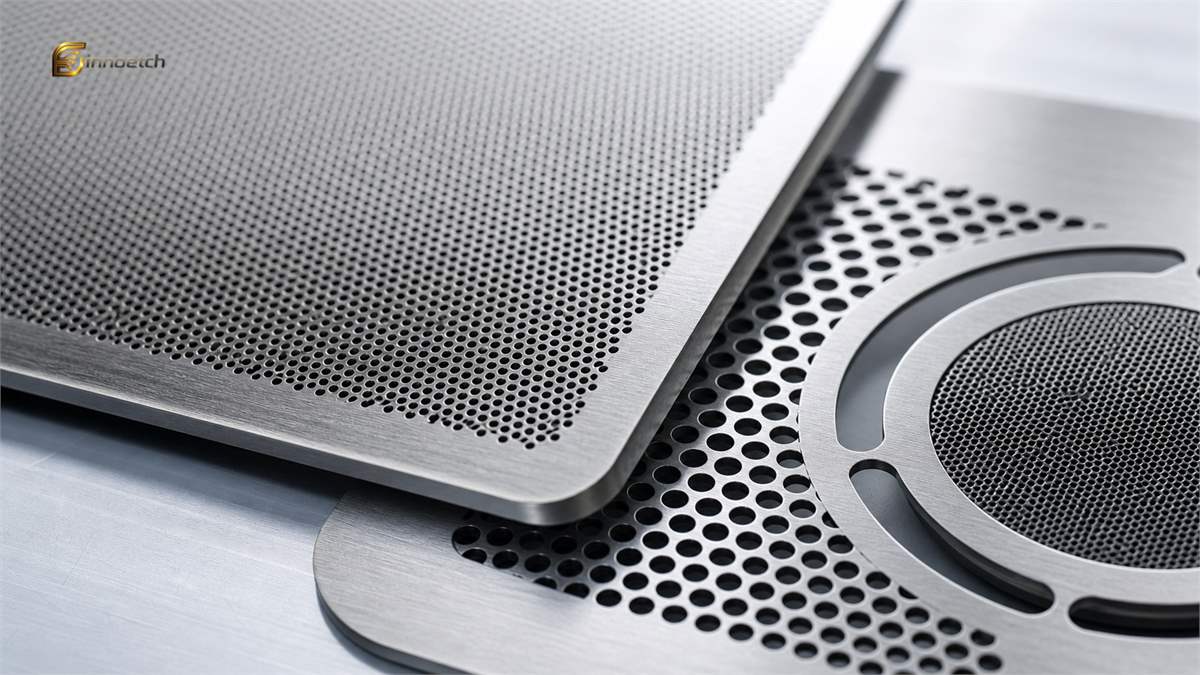
Chemical etching gives product designers more freedom than many conventional metal fabrication methods. It can produce round holes, hexagonal patterns, slots, decorative arrays, brand-specific grille patterns, and complex contours in a single process.
For audio manufacturers, the main benefits include:
Better acoustic consistency
Uniform hole geometry and open area ratio help support predictable sound transmission.
Burr-free edges
Etched openings reduce the risk of rough edges that may affect assembly, coating, or product feel.
Fast design iteration
CAD-based tooling allows faster prototype changes compared with hard tooling.
High visual quality
Fine etched patterns create a clean, premium look for visible speaker covers.
Reliable customization
Different grille shapes, hole sizes, and mesh densities can be tailored to the product structure.
Innoetch supports audio component projects from early design validation to production supply. Customers can provide drawings, material requirements, target thickness, hole patterns, and acoustic or assembly constraints. Our engineering team reviews manufacturability and helps optimize the design for etching performance.
Whether the project requires a decorative speaker grille, a protective acoustic mesh, a microphone mesh, or a precision perforated metal cover, chemical etching can reduce tooling barriers and improve design flexibility.
Metal etching is an effective manufacturing solution for speaker grilles and acoustic mesh that require fine perforations, burr-free quality, and customized design. By combining photochemical precision with material flexibility, Innoetch helps audio brands create components that look refined, assemble cleanly, and support stable acoustic performance.
If you need custom metal etching solutions for speaker grilles, acoustic mesh, or other precision audio components, Innoetch can support your project from prototype development to volume production.
Metal Etching Solutions for Speaker Grilles and Acoustic Mesh is widely used in precision metal etching applications where clean edges, tight tolerances, complex patterns and stable performance are required. Typical industries include electronics, semiconductors, sensors, fuel cells, acoustic components, EMI shielding, thermal management and precision mechanical parts.
Metal Etching Solutions for Speaker Grilles and Acoustic Mesh is a precision metal component manufactured by photochemical etching for applications requiring accurate dimensions, smooth edges and reliable performance.
Common materials include stainless steel, copper, brass, nickel silver, titanium, aluminum and other thin metal sheets depending on the application requirements.
INNOETCH can process thin metal materials from approximately 0.02 mm to 1.5 mm, depending on material type, part structure and tolerance requirements.
For many precision etched parts, tolerances can reach ±0.01 mm to ±0.05 mm, depending on material thickness, design complexity and production volume.
Chemical etching does not require expensive hard tooling and can produce fine patterns, complex shapes and burr-free edges without mechanical deformation.
Yes. INNOETCH supports custom drawings, materials, thicknesses, hole patterns, surface finishes, dimensions and prototype-to-mass-production requirements.
2D drawings, DXF files, DWG files, STEP files, material requirements, thickness, tolerance, quantity and application details are recommended for accurate quotation.
You can send your drawings and technical requirements to INNOETCH. Our engineering team will review the design and provide a quotation.